
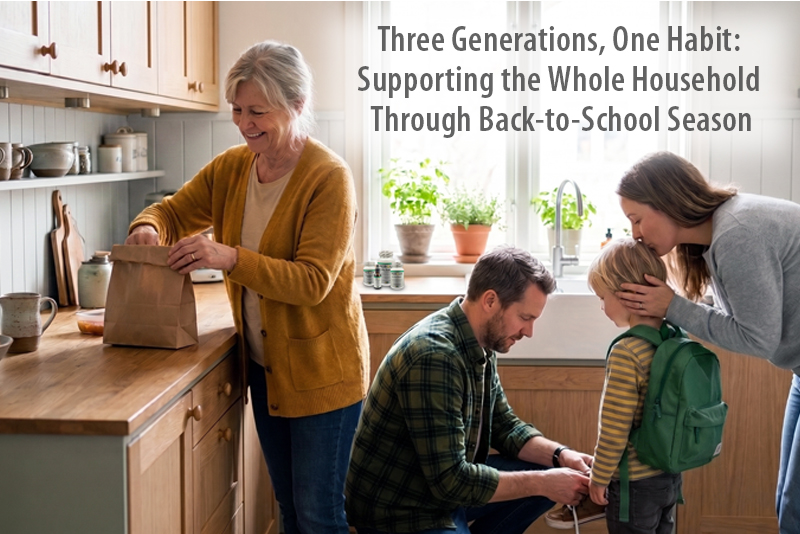
The school-year routine touches more than one generation. A grandparent picking up carpool duty a few mornings a week, a parent packing lunches and managing homework schedules, and a child adjusting to a new classroom are all navigating the same season, each with a different body doing different work. Nutrient needs shift across a lifetime, and while back-to-school planning tends to focus on kids, it’s a good time to look at what each stage of that routine actually requires, for every generation involved, from the child heading into a new classroom to the adults managing the household around them.
In This Article
For Grandparents
Aging changes how efficiently the body produces vitamin D from sunlight, with older adults generating significantly less than younger adults from the same sun exposure. This is relevant to bone and muscle health. A large study of community-dwelling older adults in England found that vitamin D deficiency was associated with impaired muscle strength and physical performance, as well as lower bone mineral density. Meta-analyses have found that daily vitamin D doses of 20 to 25 mcg are associated with lower fracture risk and fall risk in older adults, and vitamin D combined with calcium has been shown to significantly reduce fall incidence. Vitamin D also plays a role in immune function at a life stage when the immune system naturally becomes less responsive, a process researchers call immunosenescence.
Aging also affects other nutrients beyond vitamin D. B12 deficiency is estimated to affect 10 to 15% of adults over 60, largely due to reduced stomach acid and reduced intrinsic factor production with age, both of which make it harder to absorb B12 naturally from food. Hydroxocobalamin is a bioavailable form of B12 that occurs naturally in food and remains in the bloodstream longer than cyanocobalamin, the synthetic form commonly used in supplements for its affordability and stability.
For a grandparent staying active with school pickups, weekend outings, or simply keeping pace with grandkids, this combination of bone, muscle, immune, and B12 support is directly tied to physical resilience and independence.
For Parents
Vitamin D deficiency is common among working-age adults too. A study of 634 healthy adults ages 18 to 50 found that 39% had deficient vitamin D levels and 64% fell below optimal levels, with a lack of multivitamin use identified as one of several factors linked to lower status in this age group. Parents juggling work schedules, school logistics, and household routines often spend much of the day indoors, which limits the kind of consistent sun exposure that supports the body’s natural vitamin D production. As last week’s blog post covered, vitamin D status is also linked to respiratory infection risk. Parents are exposed to the same new classroom germs their kids bring home.
Vitamin D isn’t the only common gap for this age group. National nutrition survey data show that nearly half of U.S. adults consume less magnesium than recommended. Magnesium supports energy metabolism and muscle function, two things a busy parent relies on daily.
A parent managing a household’s daily supplement routine is often too occupied with schedules, meals, and other routines to think about his or her own needs.
For Kids
A study of 241 adolescent students found a positive association between vitamin D levels and academic performance. Just under half of the students studied, 48.5%, had vitamin D deficiency. Among students with poor academic performance, 55.5% were vitamin D deficient, compared to 37.9% among students with good academic performance.
Vitamin C intake has also shifted for kids over time. A large national study tracking data from 1999 to 2018 found that average vitamin C consumption declined by 23% over that period, driven mainly by a steep drop in fruit juice consumption that an increase in whole fruit intake didn’t fully make up for.
Vitamin D and vitamin C aren’t the only nutrients where gaps commonly show up. As we covered last week, a national nutrition survey found several nutrients consistently below recommended levels in U.S. children, even among children eating a fairly typical diet.
One Habit, Three Sets of Needs
Bone, muscle, and immune resilience for a grandparent, energy and immune support for a busy parent, and physical development and overall nutrition for a child each depend on a specific set of nutrients. A grandparent’s needs lean more on B12 and vitamin D. A parent’s needs lean more on magnesium and vitamin D. A child’s needs call for broader multivitamin and multimineral coverage. The recommended amount of vitamin D increases for adults over 70, but a single household routine, built around consistent daily supplementation, can support all three generations at once.
The same daily habit works for the whole family. What stays constant across all three generations is the routine itself, built into the household’s morning routine alongside everything else back-to-school season brings.
Nutrient Support for the Whole Household
PERQUE D3 Cell Guard™ provides 6.25 mcg of vitamin D3 per drop in a liquid format, allowing the dose to be adjusted drop by drop and administered easily to different members of a household.
For kids, PERQUE Life Guard™ Chewables provide 24 essential nutrients, including vitamin D and vitamin C, in forms the body can readily use, providing broader multivitamin and multimineral coverage for a child’s daily routine.
For parents and grandparents, PERQUE Life Guard™ mini offers more comprehensive coverage, with 40 essential nutrients including a super-potency B-complex and 10 fully available minerals, built for the broader nutrient needs of an adult’s daily routine.
PERQUE Mg Plus Guard™ provides magnesium in fully soluble, ionized forms, supporting the energy and muscle function demands of a busy parent’s schedule.* Pair it with PERQUE Choline Citrate™, which is formulated to support the body’s uptake of magnesium.*
PERQUE Activated B12 Guard™ delivers 2,000 mcg of B12 as hydroxocobalamin, in a dissolve-in-mouth lozenge that doesn’t require swallowing a pill.
A single household, three sets of needs, one shared habit. A grandparent supporting bone and B12 status, a parent covering magnesium and vitamin D, and a child getting broad-spectrum multivitamin coverage can all follow the same simple routine each morning throughout the school year.
*This statement has not been evaluated by the Food and Drug Administration. This product is not intended to diagnose, treat, cure or prevent any disease.

Author: PERQUE Integrative Health (PIH) Clinical Team
Every resource on the PERQUE blog is crafted by the PIH Clinical Team, a multidisciplinary panel of functional medicine, pharmacy and nutrition experts led by immunologist Dr. Russell Jaffe, MD, PhD. Discover actionable strategies designed to optimize your physiology and restore lasting wellness.