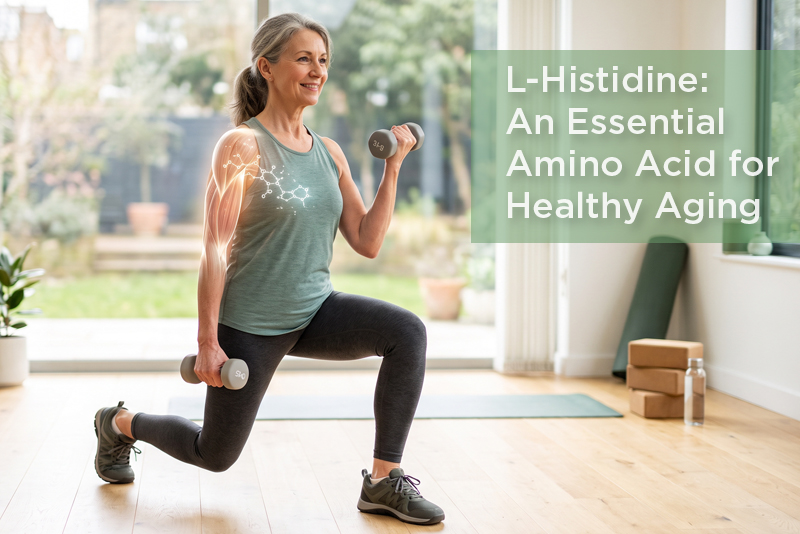
Healthy aging depends in part on maintaining the body’s ability to build, repair, and regulate its tissues. Amino acids provide many of the raw materials required for these processes. L-histidine is one of nine essential amino acids, meaning the body cannot produce enough to meet its needs and must obtain it from food.
In This Article
Once absorbed, histidine enters the body’s amino acid pool and can be incorporated into proteins or used to produce other biologically active compounds. It also has chemical properties that allow it to participate directly in processes such as proton buffering and metal binding. These multiple roles make L-histidine relevant to several aspects of normal physiology, including muscle function and tissue maintenance.
L-Histidine Has an Unusual Chemical Structure
The distinctive feature of L-histidine is its imidazole side chain. This structure can accept or donate hydrogen ions under physiological conditions, allowing histidine to participate in acid-base regulation. Histidine can also bind certain metal ions and participate in chemical reactions involving reactive oxygen and nitrogen species.
Histidine’s ability to accept and donate hydrogen ions makes it useful in the active sites of enzymes, where chemical reactions take place. In some enzymes, histidine transfers hydrogen ions during a reaction, helping the enzyme convert one substance into another.
Carnosine, a compound made from L-histidine and beta-alanine, is concentrated in skeletal muscle. Its imidazole group binds hydrogen ions, helping buffer the increase in hydrogen ions that occurs during intense muscle activity.
What Does L-Histidine Do?
L-histidine has several distinct functions throughout the body.
- Helps build proteins. L-histidine is incorporated into proteins throughout the body, where it contributes to protein structure and function. The body continually breaks down and rebuilds proteins, requiring a steady supply of essential amino acids for muscle and tissue maintenance.
- Participates in acid-base chemistry. Histidine’s imidazole group can accept or donate hydrogen ions under physiological conditions, allowing it to participate in proton buffering and acid-base regulation.
- Supports muscle chemistry through carnosine. Carnosine is concentrated in skeletal muscle, where it helps buffer the increase in hydrogen ions that occurs during intense muscle activity, helping maintain conditions for muscle contraction.
- Helps enzymes carry out chemical reactions. Histidine is part of the active sites of some enzymes, where its ability to transfer hydrogen ions helps drive specific reactions. In serine proteases such as trypsin, histidine works with other amino acids in the enzyme to help break peptide bonds.
- Provides the starting material for histamine. The body converts L-histidine into histamine, a signaling molecule involved in immune responses, stomach acid secretion, blood vessel regulation, and communication within the nervous system.
- Binds certain metal ions. Histidine can bind metal ions such as zinc, copper, and iron. In some proteins, histidine helps hold these metals in the positions where they are needed for the protein to function.
- Helps support hemoglobin structure and function. Histidine within hemoglobin helps bind and position the iron-containing heme groups, which enable hemoglobin to carry oxygen in red blood cells. Histidine also participates in the binding and release of hydrogen ions, contributing to hemoglobin’s role in buffering changes in blood acidity.
L-Histidine, Muscle, and Aging
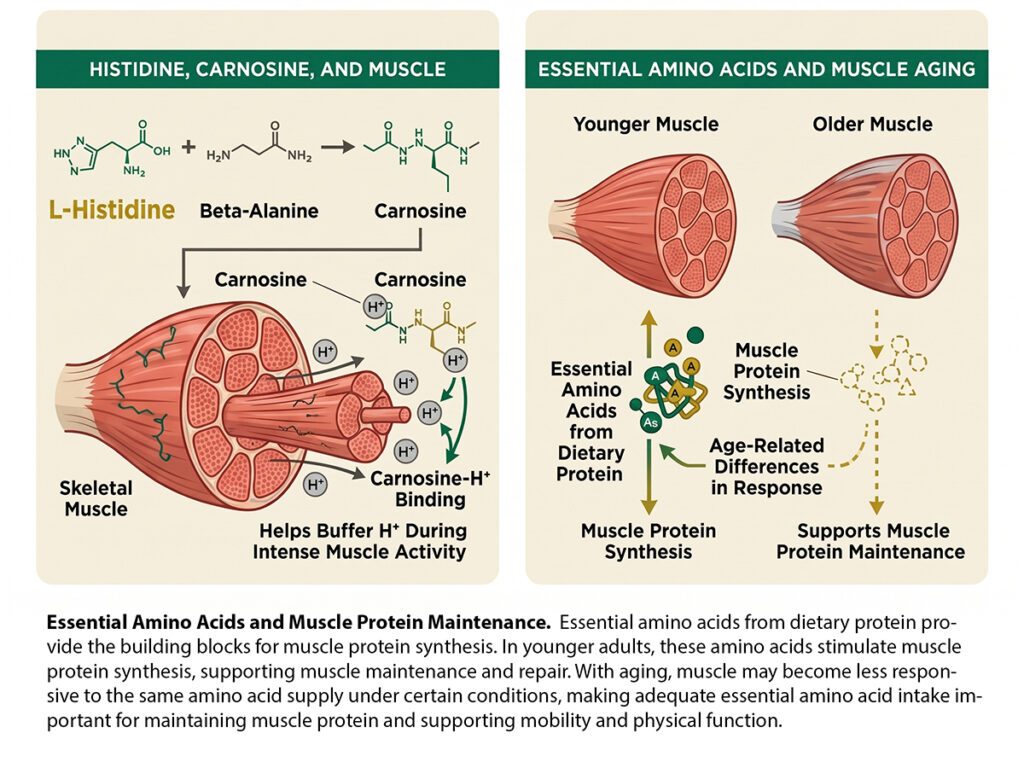 Muscle is especially important to healthy aging because maintaining muscle mass and function supports mobility and physical independence. Muscle contains a large store of protein that can be broken down to release amino acids for other tissues and metabolic processes when food intake is limited or the body has increased demands for protein. Maintaining adequate dietary protein and essential amino acid intake helps support the ongoing balance between muscle protein breakdown and synthesis. Research shows that older muscle can respond differently to essential amino acids than younger muscle, making adequate amino acid intake important for maintaining muscle protein.
In a study of 263 healthy people ages 9 to 83, researchers measured carnosine levels in two skeletal muscles using magnetic resonance spectroscopy. Muscle carnosine decreased by about 16% from young adulthood to middle adulthood in both men and women. Carnosine levels in older adults were not significantly lower than those in middle-aged adults. The findings indicate that the age-related changes occurred mainly during early and middle adulthood, with little additional decline in the older group.
Why Essential Amino Acids Matter With Age
The body continually builds and breaks down proteins throughout adulthood. Essential amino acids must come from food to replace those used in this process and maintain muscle and other tissues.
Human research also provides evidence of histidine’s role in protein metabolism. In one controlled study, four healthy adults followed a histidine-free diet for 48 days. During that period, whole-body protein turnover declined by 24–28%, while blood levels of albumin and transferrin decreased by 12% and 17%, respectively. The researchers described these changes as an adaptation to prolonged histidine depletion, providing evidence that dietary histidine contributes to normal protein metabolism.
A 2016 systematic review by Shad, Thompson, and Breen examined how muscle protein synthesis responds to exercise and amino acid-based nutrition in younger and older adults. The review found that age-related differences in muscle protein synthesis depend in part on the nutritional and exercise conditions studied. This research helps explain why adequate protein and essential amino acid intake matter for maintaining muscle with age.
Supporting the Building Blocks
Food supplies L-histidine through protein-rich foods, including meat, poultry, fish, eggs, and dairy products. The amount of histidine provided by food depends on both the protein content of the diet and the amino acid composition of those proteins. Eating a variety of protein-rich foods helps provide the essential amino acids needed for ongoing protein synthesis and tissue maintenance. After absorption, histidine can be used to build proteins or produce other compounds, including histamine and carnosine.
PERQUE L-Histidine Guard™
PERQUE L-Histidine Guard™ provides a concentrated source of this essential amino acid as part of a nutritional approach to maintaining normal protein metabolism and tissue maintenance.*
L-histidine supplies the body with an essential amino acid needed for protein synthesis and the production of histamine and carnosine. Adequate dietary protein and essential amino acid intake, combined with regular movement, nutritious food, adequate sleep, and recovery, help maintain the foundations for staying active, participating fully, and living fully throughout adulthood.*
*These statements have not been evaluated by the Food and Drug Administration. This product is not intended to diagnose, treat, cure, or prevent any disease.

Author: PERQUE Integrative Health (PIH) Clinical Team
Every resource on the PERQUE blog is crafted by the PIH Clinical Team, a multidisciplinary panel of functional medicine, pharmacy and nutrition experts led by immunologist Dr. Russell Jaffe, MD, PhD. Discover actionable strategies designed to optimize your physiology and restore lasting wellness.