

Think about reaching for a glass of water. Your brain determines where the glass is and coordinates the movement needed to pick it up. Signals travel through nerves to the muscles of your arm and hand, where they trigger the contractions that allow you to reach, grasp, and lift.
In This Article
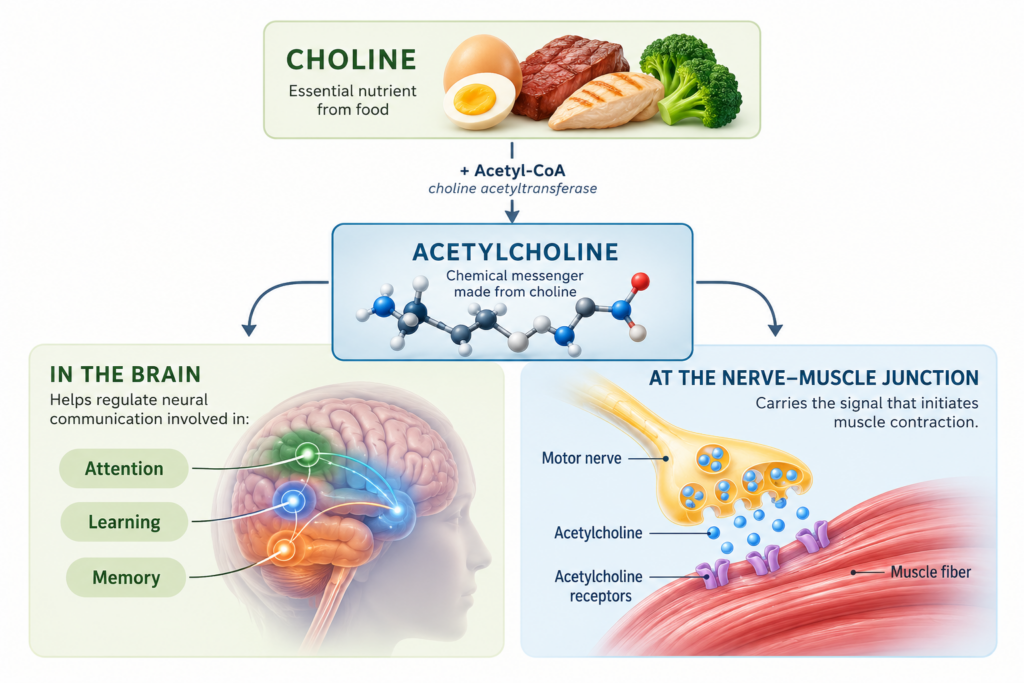
One of the chemical messengers involved in this communication is acetylcholine, a neurotransmitter with important roles in both the brain and body. In the brain, acetylcholine participates in processes involved in attention, learning, and memory. At the point where nerves meet skeletal muscles, it carries the signal that initiates muscle contraction. The body makes acetylcholine from choline, an essential nutrient obtained from food and produced in limited amounts by the body.
How the Body Uses Choline
Once available, choline has several other jobs, with the body drawing on it for different physiological needs. It is used to produce phosphatidylcholine and sphingomyelin, two major components of cell membranes. It contributes methyl groups used in metabolism and plays an important role in the transport and metabolism of fats.
To produce acetylcholine, an enzyme called choline acetyltransferase joins choline with acetyl-CoA. The newly formed acetylcholine is stored inside the nerve cell until an electrical signal triggers its release. It then crosses the tiny gap between cells and binds to receptors on the receiving cell, allowing the message to continue. What happens next depends on where that signal is traveling and the type of cell receiving it.
From Nerve Signal to Muscle Movement
Go back to that glass of water. Once your brain has initiated the movement, the message must eventually reach the muscles that will carry it out. The final handoff takes place at the neuromuscular junction, the specialized meeting point between a motor nerve and a skeletal muscle fiber.
When an electrical signal reaches the end of the motor nerve, acetylcholine is released into the tiny space between the nerve and muscle. It travels across that space and binds to acetylcholine receptors on the muscle fiber. This opens ion channels in the muscle membrane and starts a new electrical signal within the muscle itself. That signal leads to the release of calcium inside the muscle fiber, setting in motion the interactions between muscle proteins that produce contraction.
The acetylcholine signal is deliberately short-lived. An enzyme called acetylcholinesterase rapidly breaks down acetylcholine after it has delivered its message, helping end the signal so the muscle is ready to respond again. This rapid sequence—from nerve impulse to acetylcholine release to muscle response—is repeated every time skeletal muscles are called into action.
Acetylcholine in the Brain
Acetylcholine also carries messages within the brain, where its effects depend on which nerve cells release it and where those signals are received. Several acetylcholine-producing pathways extend into brain regions involved in attention, learning, and memory, allowing this neurotransmitter to influence how information is processed.
One of acetylcholine’s important roles is helping the brain direct attention toward information that matters. When you concentrate on a conversation in a noisy room, learn a new skill, or focus on directions in an unfamiliar place, the brain must prioritize certain incoming signals while filtering out competing information. Acetylcholine helps regulate neural activity involved in that selective attention.
Attention and memory are closely connected because information first has to be noticed and processed before it can be learned and later recalled. Acetylcholine signaling also influences activity in the hippocampus and other brain regions involved in forming new memories. Its role therefore reaches across several steps in the process—from paying attention to new information to the neural changes that allow some of that information to become part of memory.
The Experiment That Revealed Chemical Signaling
In 1921, physiologist Otto Loewi performed an experiment inspired by an idea that reportedly came to him in a dream. He stimulated the vagus nerve of a frog’s heart, causing the heart to slow, then transferred fluid surrounding that heart to a second frog heart. The second heart slowed too, providing evidence that the nerve had released a chemical substance into the fluid. Loewi called it Vagusstoff; subsequent work established its identity as acetylcholine. The experiment helped demonstrate that nerves can communicate through chemical messengers and contributed to the work for which Loewi and Henry Dale shared the 1936 Nobel Prize in Physiology or Medicine.
Getting Enough Choline
How much choline do we need? The National Academies established an Adequate Intake of 550 mg per day for adult men and 425 mg per day for adult women, with higher amounts recommended during pregnancy and breastfeeding. Individual choline requirements can also be influenced by factors such as hormonal status and genetics.
Estrogen increases expression of the gene for an enzyme involved in the body’s production of phosphatidylcholine, allowing the body to make more of its own choline-containing compounds. Genetic differences affecting this pathway and other aspects of choline metabolism can also influence how efficiently the body produces and uses choline.
Many Americans fall short of the established Adequate Intake levels. National dietary survey data cited by the National Institutes of Health found average choline intakes from foods and beverages of about 402 mg per day for men and 278 mg per day for women. Choline is found in a variety of foods, but the amount varies considerably. A large hard-boiled egg provides about 147 mg, while 3 ounces of roasted beef provides about 117 mg, 3 ounces of roasted chicken breast about 72 mg, and a half-cup of cooked broccoli about 31 mg.
Supporting Choline Intake
 Certain physiological stages e.g., pregnancy/lactation, require choline intake above the Adequate Intake levels. When additional choline is needed to help meet daily health goals, supplementation provides another source. PERQUE Choline Citrate™ provides choline in a liquid choline citrate formula, with 650 mg of choline per teaspoon. The liquid format provides a convenient alternative to tablets or capsules and can be diluted in water or juice. Choline citrate also has a unique relationship with magnesium. When choline citrate is taken together with magnesium, the compounds can form electrically neutral complexes that have been studied for their ability to facilitate magnesium uptake.*
The importance of choline becomes easier to appreciate when we return to something as ordinary as reaching for a glass of water. Long before your fingers close around the glass, your brain is processing information, your nervous system is carrying instructions, and your muscles are preparing to respond. Acetylcholine helps carry those messages, and choline provides the nutritional starting material the body needs to make it. The entire sequence happens in moments, turning an intention to move into an action we barely have to think about.
*These statements have not been evaluated by the Food and Drug Administration. This product is not intended to diagnose, treat, cure, or prevent any disease.

Author: PERQUE Integrative Health (PIH) Clinical Team
Every resource on the PERQUE blog is crafted by the PIH Clinical Team, a multidisciplinary panel of functional medicine, pharmacy and nutrition experts led by immunologist Dr. Russell Jaffe, MD, PhD. Discover actionable strategies designed to optimize your physiology and restore lasting wellness.