

Joint pain, low energy, and muscle loss are often treated as three separate problems, each with its own explanation and its own fix. Research on aging suggests they share the same underlying causes, and that each one tends to accelerate the others as it develops.
In This Article
Frailty as a Systems Problem
Researchers studying frailty in older adults have identified a consistent pattern involving three interconnected processes: mitochondrial dysfunction, oxidative stress, and the loss of muscle and bone mass. These describe the underlying biological changes that can contribute to declining physical function as we age. Mitochondria are the structures within cells responsible for producing energy, and as mitochondrial function becomes less efficient, reactive oxygen species can increase, contributing to oxidative stress. This oxidative stress can affect tissues throughout the body, including muscle fibers and joint cartilage, both of which depend on adequate cellular energy to maintain normal function.
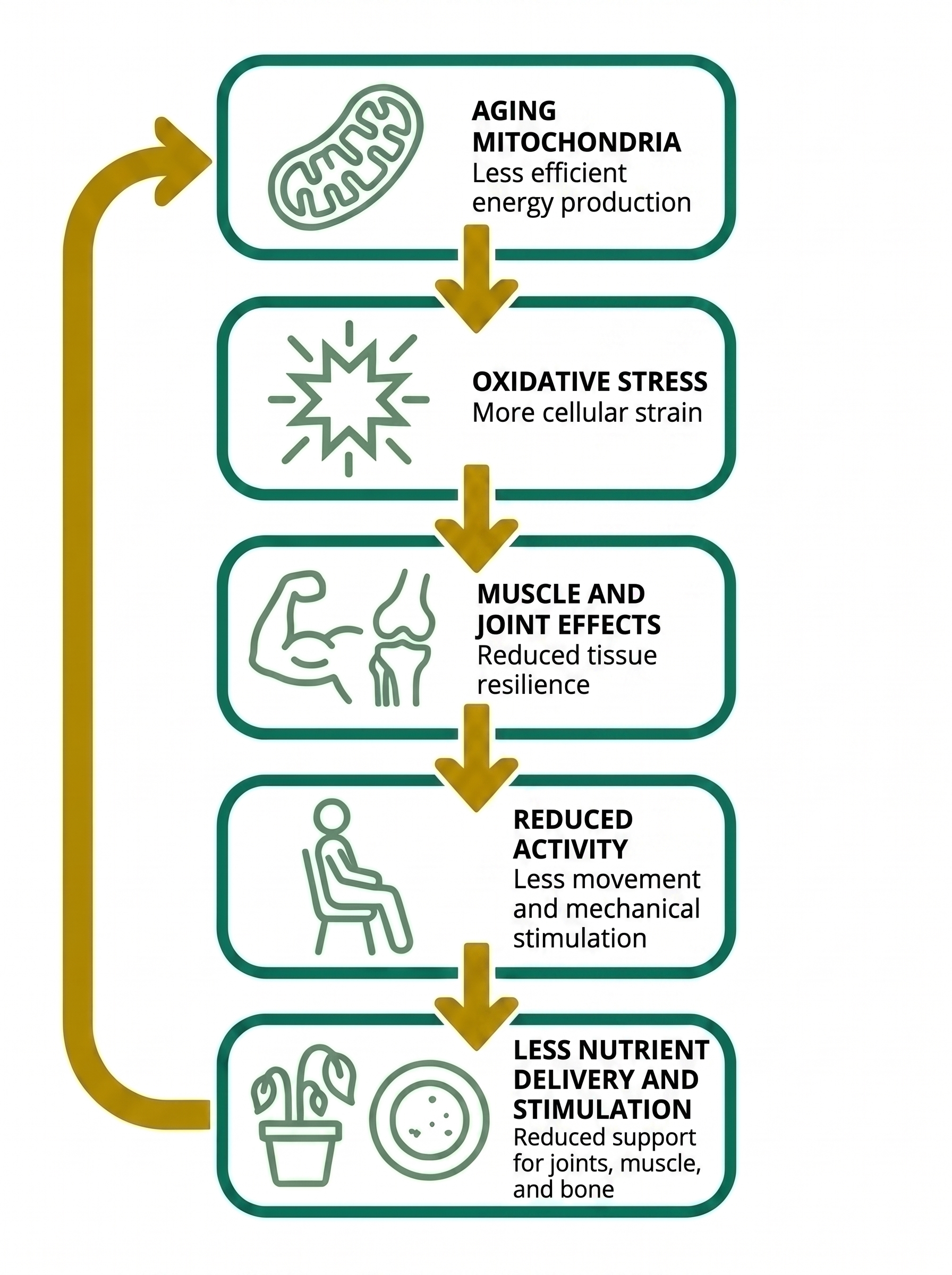
Cartilage is particularly vulnerable because it has no blood supply of its own. Instead, it depends on joint fluid and movement to deliver nu
trients and remove waste. This makes joint health an important point of convergence for these age-related changes. As muscle and bone mass decline, physical activit
y often declines as well, reducing the movement and mechanical stimulation that joints depend on while further limiting the demands placed on muscles and cells. Toge
ther, these changes can make it harder for the musculoskeletal system to maintain resilience with age.
Chronic low-grade inflammation is a related part of this picture. Immune cells depend on the same cellular energy processes as other ti
ssues, and as that process becomes less efficient, immune cells tend to release more inflammatory signaling proteins into the bloodstream. These circulating signals can act on tissue throughout the body, adding further strain to joints, muscles, and the cellular repair processes already working to keep up with age-related demands.
Clinicians who study this pattern describe it using a specific set of markers. A person is generally considered to show signs of frailty when at least three of the following are present: unintentional weight loss, self-reported exhaustion, measured muscle weakness, slow walking speed, and low physical activity. A nationally representative U.S. study found that 15% of adults 65 and older meet this frailty threshold, and another 45% are considered ‘prefrail,’ showing one or two of these markers without yet meeting the full criteria.
This has practical implications for how healthy aging support should be approached. A separate body of research looks at what happens when frailty is addressed directly. A 2026 network meta-analysis of frailty interventions found that combining regular physical activity with nutritional support produced greater improvements in frailty scores than either approach alone. This is consistent with these systems’ reliance on both mechanical stimulation from movement and nutrient support.
Four Systems, Four Kinds of Support
These three interconnected processes affect multiple systems involved in physical function. From a nutritional support perspective, four areas are particularly relevant: joint and cartilage function, cellular antioxidant defense, cellular energy production, and muscle and tissue resilience. Each calls for a different kind of nutritional support: cartilage needs building-block nutrients to maintain its structure, cellular defenses need antioxidants to help manage oxidative stress, mitochondria need specific metabolic cofactors to support energy production, and muscle tissue needs amino acid precursors for the compounds it relies on during activity. Together, these forms of nutritional support address different aspects of the interconnected processes that contribute to physical function.
Joint and cartilage function. Cartilage has no blood supply of its own. It relies on the surrounding joint fluid, and on movement to help circulate that fluid, to receive nutrients and clear waste. Its structural components, including specific sugars and proteins that give cartilage its cushioning properties, need a steady supply of raw materials to be maintained over time. PERQUE Joint Guard™ provides two forms of glucosamine and chondroitin sulfate, along with OPC antioxidants, nutrients that support healthy cartilage and joint function, helping maintain everyday mobility.*
Cellular antioxidant defense. Energy production inside mitochondria naturally generates reactive oxygen species as a byproduct, and the body relies on its antioxidant systems to keep that activity in balance. This defense system can be additionally supported through targeted nutrition, particularly as oxidative load tends to increase with age. PERQUE Repair Guard™ provides a blend of quercetin dihydrate, pomegranate juice, and OPC antioxidants to support the body’s natural antioxidant defenses and healthy cellular function.*
Cellular energy production. Since mitochondrial efficiency sits at the center of the systems described above, supporting the specific nutrients mitochondria depend on is a foundational piece of this picture. CoQ10 functions as an electron carrier within the mitochondrial electron transport chain, the process that generates cellular energy. PERQUE Mito Guard 100 Plus™ provides CoQ10 to support cellular energy production, cardiovascular health, and healthy muscle function.*
Muscle and tissue resilience. Amino acids play a supporting role in tissue maintenance and in the body’s production of compounds that muscle tissue relies on during activity. PERQUE L-Histidine Guard™ provides L-histidine, an amino acid that supports healthy tissue, immune function, and the body’s production of anserine and carnosine, compounds that support healthy muscle and skeletal function.*
Why the Whole Picture Matters
All four areas work together: joint and cartilage function, antioxidant defense, cellular energy, and muscle and tissue resilience. A cell with efficient mitochondria and strong antioxidant defenses helps support the normal maintenance of surrounding tissue, whether that tissue is cartilage, muscle, or bone. Muscle tissue and regular movement, in turn, support circulation and nutrient delivery back to the joints. Movement also provides mechanical stimulation that helps maintain healthy muscle and bone function. These systems interact directly, which is part of why frailty researchers assess multiple markers together. Looking at these connections can help put individual aspects of healthy aging into a broader context
This is the basis for a systems-based approach to healthy aging: supporting the underlying systems that keep the body functioning well as a whole. In practice, healthy aging involves more than any single aspect of physical function. Joint health, cellular energy, antioxidant defenses, muscle function, and regular movement all contribute to maintaining mobility and everyday physical function.
Four products, one goal: helping the body’s interconnected systems for movement, energy, and repair work the way they’re designed to.
Over the next several weeks, we’ll take a closer look at each of these systems individually, starting with new research on how something as simple as daily movement affects joint health at the cellular level.
*These statements have not been evaluated by the Food and Drug Administration. These products are not intended to diagnose, treat, cure, or prevent any disease.

Author: PERQUE Integrative Health (PIH) Clinical Team
Every resource on the PERQUE blog is crafted by the PIH Clinical Team, a multidisciplinary panel of functional medicine, pharmacy and nutrition experts led by immunologist Dr. Russell Jaffe, MD, PhD. Discover actionable strategies designed to optimize your physiology and restore lasting wellness.