
Most people notice energy dips at some point during the day. Maybe it’s a mid-morning slump at work, or that late-afternoon heaviness that makes focusing on even small tasks a challenge. These experiences are familiar, but beneath them, energy is produced and coordinated continuously within every cell of your body, supporting every heartbeat, thought, and movement.
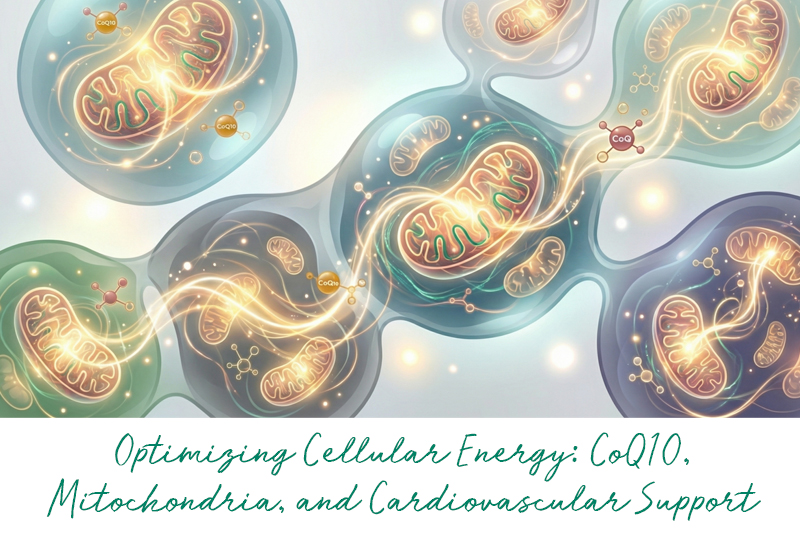
At the core of this process are mitochondria—the tiny cellular structures responsible for generating adenosine triphosphate (ATP), the molecule that fuels biological activity. ATP is the currency of energy that powers cellular work throughout the body. Efficient mitochondria ensure that energy is steady, sustainable, and synchronized across organs, particularly in tissues with high demand, like the heart, brain, and skeletal muscles. Understanding how mitochondria function, and how nutrients like CoQ10 support them, provides insight into the body’s remarkable ability to sustain cellular performance and cardiovascular coordination.
What Mitochondria Actually Do
Mitochondria are often called the powerhouses of the cell, but this nickname only scratches the surface. Each mitochondrion is a complex, highly organized structure where a cascade of chemical reactions converts the nutrients from your diet into ATP. This process is called cellular respiration, and it happens in several stages.
Carbohydrates, fats, and proteins are broken down into smaller molecules that mitochondria can use. Inside the mitochondrion, the electron transport chain—an array of specialized proteins embedded in the inner mitochondrial membrane—shuttles electrons derived from these nutrients. As electrons move along the chain, energy is released and captured in the form of ATP. Oxygen plays a central role as the final electron acceptor, allowing the chain to function continuously.
The heart alone contains thousands of mitochondria per cell, reflecting its constant energy requirement. Brain neurons and skeletal muscle fibers also have dense populations of mitochondria, ensuring that energy production keeps pace with functional demand. Every movement, every neural signal, every heartbeat is supported by this finely tuned cellular machinery.
Where CoQ10 Fits Into the Energy Pathway
Coenzyme Q10 (CoQ10) is a lipid-soluble molecule that sits within the inner mitochondrial membrane, where it plays a critical role as an electron carrier in the electron transport chain. By transferring electrons between complexes in the chain, CoQ10 facilitates the creation of the proton gradient that drives ATP synthesis. CoQ10 also serves as a protective agent for mitochondria. Its antioxidant activity helps maintain the integrity of mitochondrial membranes, reducing oxidative stress and supporting the proper function of the electron transport chain.
Natural production of CoQ10 declines with age. Certain medications, including statins, can further deplete CoQ10 levels. Statins work by inhibiting the enzyme HMG-CoA reductase, which is critical not only for cholesterol synthesis but also for CoQ10 production. This dual effect means that anyone taking a statin—or even red yeast rice, which acts similarly—may have reduced CoQ10 availability, potentially impacting energy efficiency. Supplementing with a stable, bioavailable form of CoQ10 helps maintain continuous ATP production, supporting cellular coordination and sustained energy across tissues. Because CoQ10 is embedded directly within the inner mitochondrial membrane, its availability influences both the speed and efficiency of electron flow within the energy pathway.
Energy Efficiency and Cardiovascular Function
The heart’s demand for ATP is constant and substantial. Each contraction, each electrical impulse, and each cycle of nutrient uptake and waste removal relies on mitochondria functioning at peak efficiency. Cardiac cells contain particularly high densities of mitochondria to meet this unceasing energy requirement.
Mitochondrial membranes are sensitive structures. Oxidative stress or shifts in redox balance—the equilibrium between oxidized and reduced molecules—can affect membrane stability and ATP production. Maintaining mitochondrial integrity is essential not only for steady energy output but also for cardiovascular function. When ATP production remains aligned with cardiovascular demand, the heart and circulatory system operate efficiently, sustaining both immediate function and long-term resilience.
Nutrient Synergy Within Mitochondria
Several nutrients work together within mitochondria to support energy efficiency and membrane integrity.
- CoQ10: Facilitates electron transfer and protects mitochondria from oxidative stress.
- Mixed tocopherols: Provide membrane-phase antioxidant protection, preserving lipid integrity.
- Beta carotene: A lipid-phase antioxidant that supports membrane stability.
- Gamma oryzanol: Enhances lipid stability and supports redox balance.
These nutrients are particularly effective when delivered in a fat-soluble form, which mirrors the natural environment of mitochondrial membranes. Fat-soluble delivery allows for absorption and incorporation into mitochondrial membranes, where energy production and antioxidant protection converge.
PERQUE®’s Formulation Philosophy
PERQUE Mito Guard 100 Plus™ is designed to reflect the physiological needs of mitochondria. It uses soluble ubiquinone in a micellized form—dispersed into tiny droplets to enhance assimilation and cellular uptake. The formulation includes mixed natural tocopherols—alpha, beta, gamma, and delta—alongside whole-carotenoid beta carotene derived from palm fruit. Gamma oryzanol is incorporated to enhance lipid stability and maintain redox balance. This design ensures that cellular energy is produced and coordinated efficiently, supporting cardiovascular function and cellular resilience.
Energy as a Marker of Cellular Coordination
When ATP production is optimized, and redox balance is maintained, the cells, mitochondria, and tissues communicate and perform in unison. In the heart, this coordination ensures that every beat is powered reliably, sustaining blood flow and oxygen delivery throughout the body. In skeletal muscles, it supports consistent performance and endurance. In neurons, it enables ongoing signaling, cognition, and metabolic integration. Viewed this way, energy becomes a marker of cellular efficiency, integrity, and long-term resilience.
Supporting Mitochondrial Coordination Every Day
Cellular energy is influenced by nutrient availability, mitochondrial integrity, and redox balance. Nutrients that directly interact with mitochondrial membranes—CoQ10, tocopherols, beta carotene, and gamma oryzanol—ensure that ATP production is steady and synchronized across high-demand tissues. PERQUE Mito Guard 100 Plus™ delivers these compounds in a form optimized for uptake and physiological impact, supporting the coordination of energy from the cellular level up. Supporting mitochondria consistently with targeted nutrients helps maintain ATP production, preserves membrane stability, and reinforces the body’s ability to sustain coordinated function over time.
Conclusion
Cellular energy is complex, coordinated, and continuous. Efficient mitochondria supported by CoQ10 and complementary nutrients sustain the energy required by the heart, brain, and muscles. By maintaining mitochondrial integrity, supporting redox balance, and delivering essential cofactors in bioavailable forms, energy becomes a reflection of cellular efficiency and resilience. PERQUE Mito Guard 100 Plus™ exemplifies this approach, providing the nutrients necessary to support the inner workings of the cell while reinforcing cardiovascular coordination and long-term vitality.

Author: PIH Team
PERQUE nutraceuticals are distinctive from the inside out. Each product represents a rethinking for how nutrients interact with the body and the impact they can have on the body’s ability to overcome the obstacles to repair and then stimulate natural healing responses.