
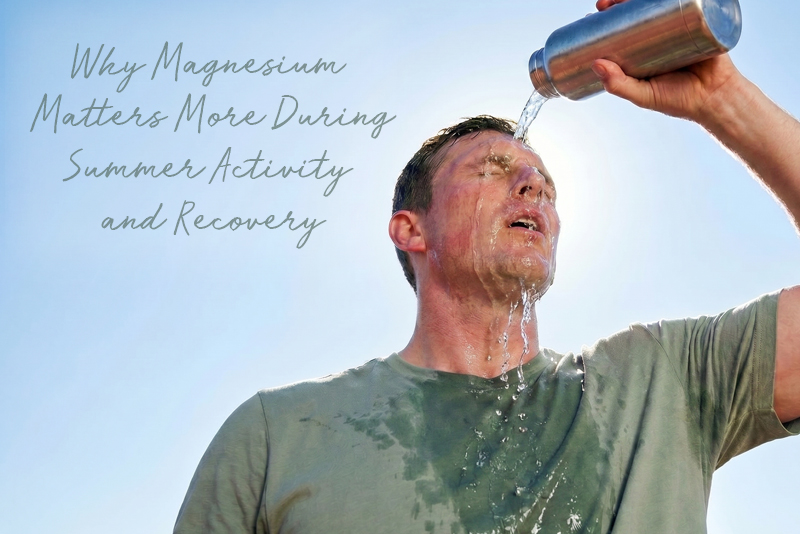
You did everything right. You got outside, you moved your body, you stayed hydrated, and ate well. Maybe you went for a long walk, worked in the garden, or spent the afternoon at the beach. And yet the next morning you woke up stiff, unrested, and more depleted than you expected. Your muscles ached longer than seemed reasonable. Sleep felt shallow despite the physical exhaustion. The activity that was supposed to energize you left you feeling like you needed to recover from the recovery.
This is a pattern many active adults recognize but rarely trace back to its source. The missing piece, more often than not, is magnesium.
The Mineral Summer Quietly Depletes
Most people are aware that magnesium is important. Fewer realize how aggressively summer activity depletes it. Magnesium is one of the primary minerals lost through sweat, alongside sodium and potassium. In summer, when even moderate activity produces significant sweat, those losses accumulate quickly. A long hike, an afternoon of yard work, or a few hours at the beach can all contribute to meaningful magnesium loss before the day is over.
Estimates suggest that nearly 70% of the population have chronic latent magnesium deficiency, largely due to factors such as soil depletion and modern agricultural practices that have reduced magnesium content in food over recent decades. Even a genuinely healthy diet rich in leafy greens, nuts, seeds, and legumes may not provide adequate magnesium to keep pace with the increased demands of an active summer. Activity depletes reserves further, sweat removes more, and the body draws on whatever remains to keep essential biochemical processes running, leaving less available for muscle recovery and overnight repair. Over time, sleep becomes less restorative, and workouts that should feel energizing become draining instead.
What Magnesium Does and What Happens When It Runs Low
Every muscle contraction in the body depends on a precise interplay between calcium and magnesium. Calcium triggers contraction, signaling muscle fibers to shorten and engage. Magnesium enables relaxation, counteracting calcium’s action and allowing muscle fibers to release. When magnesium is insufficient, muscles contract readily but struggle to fully release, resulting in cramping, tightness, and persistent muscle tension that stretching alone cannot resolve.
This relationship extends beyond skeletal muscle. Magnesium supports the electrical signals that keep the heart beating in a steady rhythm during exertion and helps blood vessels dilate appropriately to deliver oxygen and nutrients to working muscles. At the cellular level, it activates ATP, the molecule that powers every muscular contraction and metabolic reaction the body performs during physical activity. How a person feels during and after exercise (energy levels, endurance, and the speed of recovery) may reflect magnesium status more directly than most people realize.
Recovery itself depends on magnesium just as heavily as the activity that precedes it. The actual adaptation happens during sleep: repairing micro-tears in muscle tissue, laying down stronger fibers, and recalibrating the nervous system for better coordination and endurance. Magnesium activates the enzymes responsible for protein synthesis, supports melatonin production to regulate sleep depth, and binds to GABA receptors to promote the calm neural state the body needs to fully downshift after exertion. It also helps regulate cortisol, which remains elevated after intense activity and can interfere with deep sleep when magnesium is insufficient.
The result of running low is a body that cannot complete the cycle. It pushes through activity drawing on depleted reserves, then struggles to transition into the deep, restorative sleep where repair actually occurs. Morning arrives with muscles that feel less recovered than expected, energy that hasn’t fully returned, and a readiness for the next day’s activity that falls short of what it should be.
Getting Magnesium Where It Needs to Go
Supplementing magnesium can help replenish depleted stores but getting it into the body can be challenging. The body’s ability to absorb magnesium varies depending on the form taken, an individual’s digestive health, and the energy available for uptake.
Active people might reach for topical magnesium sprays or lotions when cramps strike or muscles feel tight after exertion. These products are an option for those seeking quick, localized and symptomatic relief.
Summer activity demands sustained physiological support for hormonal balance, nervous system regulation, restorative sleep, and cellular energy. Meeting those demands requires magnesium delivered systemically, in forms the body can absorb efficiently and transport to cells throughout the body without causing digestive discomfort.
PERQUE Mg Plus Guard™ combines three highly bioavailable forms — magnesium glycinate, magnesium ascorbate, and magnesium citrate — in a single formula. Because individuals absorb different forms with varying efficiency, combining all three ensures broader uptake across a wider range of metabolic profiles.*
Absorption from the digestive tract, however, is only part of the equation. Even a high-quality magnesium supplement requires adequate energy from the body’s systems to be absorbed effectively. PERQUE Choline Citrate™ supports intracellular magnesium delivery by carrying it through cell membranes as a neutral compound, bypassing the energy-dependent pathway that limits cellular uptake in many people.*
Together, PERQUE Mg Plus Guard and PERQUE Choline Citrate form a patented system designed to ensure magnesium reaches the cells that need it most — including the muscle cells, nerve cells, and cardiac cells that summer activity places under the greatest demand.*
Monitoring first morning urine pH provides a practical daily indicator of magnesium status. A reading consistently below 6.5 suggests that mineral reserves may be running low and that magnesium supplementation may be helpful.
A Foundation for the Season
The goal for most active adults is simple: move well, recover well, and feel good while doing it. Sustaining that goal depends less on fitness level than on whether the body’s foundational systems have what they need to keep pace with daily demand. Magnesium sits at the center of that equation: powering the contractions, steadying the rhythm, and quietly rebuilding overnight what the day’s activity broke down. Keeping magnesium stores consistently replenished is one of the most practical investments an active person can make to feel good throughout the months ahead.
*These statements have not been evaluated by the Food and Drug Administration. This product is not intended to diagnose, treat, cure, or prevent any disease.

Author: PIH Team
PERQUE nutraceuticals are distinctive from the inside out. Each product represents a rethinking for how nutrients interact with the body and the impact they can have on the body’s ability to overcome the obstacles to repair and then stimulate natural healing responses.