
When people think about cardiovascular health, they often picture cholesterol, blood pressure, or plaque buildup. These markers matter, but they do not tell the full story of how blood vessels function day to day. Healthy vessels depend on communication—signals that help blood vessels relax, contract, repair themselves, and respond to changing demands throughout the body.
One compound that reflects how well this communication system is functioning is homocysteine. Although it is frequently discussed as a “risk marker,” homocysteine is a normal and necessary part of human metabolism. Understanding what homocysteine is, how it is formed, and how the body manages it helps clarify why certain nutrients matter for long-term vascular support.
What Is Homocysteine?
Homocysteine is an amino acid produced when the body processes methionine, an essential amino acid obtained from protein-containing foods. This process happens constantly as part of protein turnover, tissue repair, and cellular maintenance.
Homocysteine itself is not a problem molecule. It serves as a metabolic intersection point, meaning it can move into different pathways depending on what the body needs at that moment. Under well-supported conditions, homocysteine does not accumulate. It is efficiently routed onward and reused as part of normal biochemical flow. Its levels in the blood can reflect how smoothly certain systems are working, particularly those involved in nutrient coordination and cellular signaling.
How Homocysteine Is Managed in the Body
Once homocysteine is formed, the body has two primary ways of handling it. One route allows homocysteine to be recycled back into methionine. The other route converts homocysteine into cysteine and other sulfur-containing compounds that support antioxidant activity and detoxification.
Both routes are active in healthy physiology. Which pathway is emphasized at any given time depends on nutrient availability, cellular demand, and overall metabolic context. This flexibility allows the body to adapt to stress, growth, repair, and environmental exposure without disrupting balance.
Problems can arise when coordination between these pathways becomes strained, often due to increased demand alongside insufficient nutrient support or limited regulatory capacity.
Why Homocysteine Is Measured
Homocysteine is commonly measured because it offers a window into how efficiently these routing systems are functioning. Elevated levels suggest that homocysteine is being produced faster than it is being cleared through available pathways. A goal value of <6µmol/L is recommended.
From a vascular perspective, this matters because homocysteine interacts with endothelial cells, the thin layer of cells lining blood vessels. These cells play a central role in vessel tone, flexibility, and responsiveness. When homocysteine regulation becomes inefficient, endothelial signaling can become less coordinated over time, and result in impaired blood vessel function, increased vascular inflammation, and a higher risk of heart disease and stroke.
For this reason, homocysteine is best understood as a functional indicator. It reflects how well nutrient-dependent pathways are keeping pace with metabolic demand.
Nutrients Involved in Homocysteine Regulation
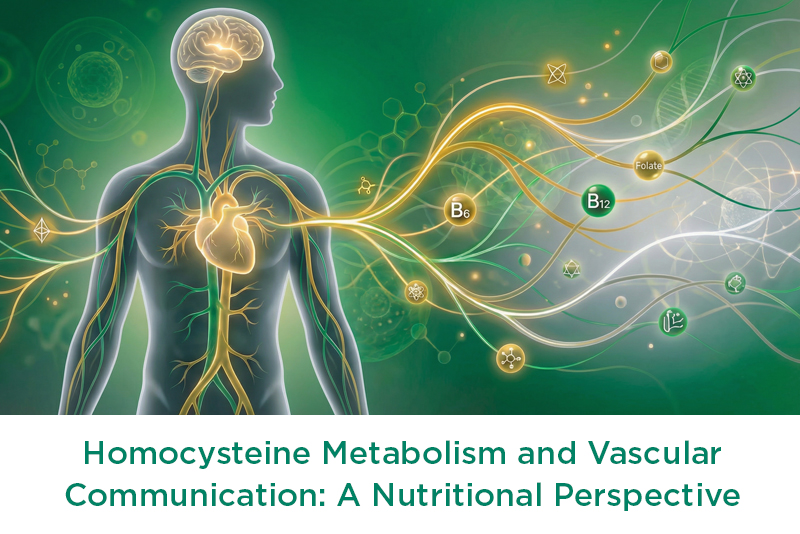
Several nutrients are required to keep homocysteine moving smoothly through its pathways. Among the most important are vitamins B12, folate, and B6. Each supports a different aspect of homocysteine handling, and their roles are complementary.
Vitamin B12 and folate support the recycling of homocysteine back into methionine. This pathway helps maintain methylation balance and supports cellular communication processes that rely on methionine-derived compounds.
Vitamin B6 supports the conversion of homocysteine into cysteine through transsulfuration. This route contributes to antioxidant capacity and sulfur metabolism, which are important for vascular resilience and metabolic flexibility.
Because these pathways operate simultaneously, effective homocysteine regulation depends on coordinated nutrient availability.
Why Nutrient Form Matters for Homocysteine Support
The form in which nutrients are delivered influences how they participate in these pathways. Some nutrient forms enter active pathways immediately. Others require conversion steps that allow the body to regulate timing and quantity.
For individuals with adequate baseline activity or higher regulatory sensitivity, immediate delivery can feel overwhelming. In these cases, precursor forms that allow gradual conversion may align more closely with physiological pacing.
This distinction is especially relevant for nutrients involved in methylation-related processes, where reaction speed influences not only homocysteine recycling but also nervous system and vascular signaling.
Vitamin B12 and Controlled Conversion
Vitamin B12 supports homocysteine recycling, but its physiological behavior depends on form. Hydroxocobalamin provides the cobalamin backbone, and the body converts it into active coenzyme forms according to demand.
This allows B12-dependent processes to proceed while preserving regulatory control. For individuals who experience overstimulation from directly methylated B12 forms, hydroxocobalamin often feels steadier and more compatible with long-term support.
By allowing the body to determine conversion rate, hydroxocobalamin supports homocysteine handling without adding unnecessary pressure to signaling systems.
Folate Support Without Excessive Methyl Load
Folate participates in homocysteine recycling and supports DNA synthesis, cellular repair, and one-carbon metabolism. Like B12, folate exists in multiple forms that differ in how directly they influence methyl availability.
Folinate provides folate support without acting as an immediate methyl donor. It maintains folate pools and supports enzyme readiness, allowing downstream reactions to proceed in step with regulatory capacity.
This approach supports homocysteine regulation while avoiding abrupt increases in methyl activity that some individuals find difficult to tolerate.
Vitamin B6 and Pathway Balance
Vitamin B6 plays a distinct role by supporting the transsulfuration pathway. This pathway offers an alternate route for homocysteine utilization that does not rely on methyl recycling alone.
By supporting this route, B6 helps distribute metabolic workload across systems. This contributes to steadier homocysteine handling and supports vascular and metabolic resilience during periods of increased demand.
Adequate B6 status also supports amino acid metabolism more broadly, reinforcing the interconnected nature of these pathways.
Homocysteine and Vascular Communication
Blood vessels are dynamic tissues that respond continuously to chemical signals, nutrient status, and mechanical forces. Endothelial cells rely on coordinated signaling to regulate dilation, contraction, and repair.
Homocysteine interacts with these signaling processes indirectly by reflecting how well supporting pathways are functioning. When homocysteine remains within a stable range, it suggests that nutrient coordination is meeting physiological demand.
Over time, supporting homocysteine handling contributes to smoother vascular responsiveness and more adaptable vessel behavior, particularly in the heart and brain, where poor regulation has been linked to cognitive decline, memory impairment, and increased risk of dementia.
PERQUE Vessel Health Guard™ and Coordinated Support
PERQUE Vessel Health Guard™ is formulated to support homocysteine regulation through coordinated nutrient delivery. Its formulation includes hydroxocobalamin, folinate, and vitamin B6, each chosen for its role in regulated metabolic flow.
Hydroxocobalamin supports B12-dependent processes with controlled conversion. Folinate sustains folate availability without forcing methyl delivery. Vitamin B6 supports transsulfuration and amino acid balance.
Together, these nutrients support the pathways that manage homocysteine while respecting individual regulatory capacity.
Supporting Vascular Health Over Time
Nutrient forms that allow the body to regulate timing and intensity support steadier physiological function over time. PERQUE’s formulation philosophy reflects this principle by focusing on nutrient forms that integrate smoothly into existing regulatory systems, supporting vascular health as part of the body’s broader communication network.

Author: PIH Team
PERQUE nutraceuticals are distinctive from the inside out. Each product represents a rethinking for how nutrients interact with the body and the impact they can have on the body’s ability to overcome the obstacles to repair and then stimulate natural healing responses.